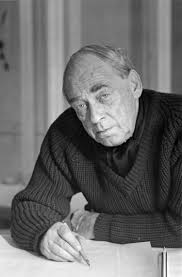
Alvar Aalto
(1898-1976)
The Nordic House is designed by the acclaimed Finnish architect Alvar Aalto.
Hugo Alvar Aalto was born in the village of Kuortane in Finland in 1898 as the oldest of three children to a Finnish speaking surveyor and a Swedish speaking postal clerk. When Alvar was five the family moved to Jyväskylä, today a total of 37 buildings in the town are Aalto designs.
In school, Alvar's favorite subject was drawing. He matriculated in 1916 and went to study architecture at the Technical University of Helsinki. 40 years later he redesigned the entire campus.
He graduated in 1921, started his own office in 1923 and married the architect Aino Marsio the year after. The young couple shared a fondness for Italy and had a gramophone in their apartment for practicing foxtrot. They had two children, Hanni and Hamilkar.
With the completion of the Paimio Tuberculosis Sanatorium in 1933 and Vyborg Library in 1935 Aalto cemented his reputation worldwide. He was not yet 40 years old.
In 1935 Artek was founded to manufacture the furniture that Aalto designed to decorate his buildings.
In 1937 he sent sketches called “Eskimo Woman's Leather Breeches” for a curvy vase to the Paris World's Fair. Today the vase is known as ‘Savoy', an international best-seller and one of the most famous glass items in the world.
Two years later Aalto designed the entire Finnish Pavilion for the New York World's fair. Frank Lloyd Wright described it as a "work of genius".
With his growing reputation and the desperate need for rebuilding after the 2nd World War, Aalto's office was thriving.
Aalto's wife Aino died of cancer in 1949. He remarried in 1952 to architect Elissa Mäkiniemi who had worked as his assistant.
In the end of the 50s Aalto received several invitations and cometition wins, such as Kiruna Town Hall (1958) for example and Aalborg Art Museum (1958). The Nordic house of Reykjavik was a commission work by the Nordic council of ministers, completed in 1968.
Aalto continued working until his death in 1976 in the age of 78. His major works also included Villa Mairea (1939), The Baker House (1948) and Finlandia Hall (1971). Among unfinished projects was a health care centre in Reykjavík.
During his 50-year-long career Alvar Aalto designed over 500 individual buildings, 300 of which were built. Aalto's diverse range of project also included town plans and designed furniture, glassware and other items. His inspiration comes from human in the foreground and a conviction for close relationships between architecture and setting, man and nature.
"Aalto" is Finnish for "wave", appropriate for a man whose work was characterized by organic lines and a sense for natural materials. He was a key figure in the international modernism and one of the most influential architects of the 20th Century.